We tear down your market. You keep the map.
What lands in your inbox
One document. Your market, mapped.
How it works
1 · Capture. The live field, pulled as it stands today: competitors' ads, funnels, pricing, and site copy, plus the search terms your buyers actually type. Your own pages go in too.
2 · Analysis. Scraping tools exist. Any of them can hand you the pile. Here the pile lands as structured data inside a system that reasons from it: every page scored on one matrix, buyer language read against competitor claims, every finding traced to a capture.
3 · The map. The captures and analysis compress into one document: where you stand, who owns what, the open ground, and the moves in priority order. The first pass is the baseline.
A map is a photo of a moving field. Clients keep the camera running: systems building.
A page from a real one
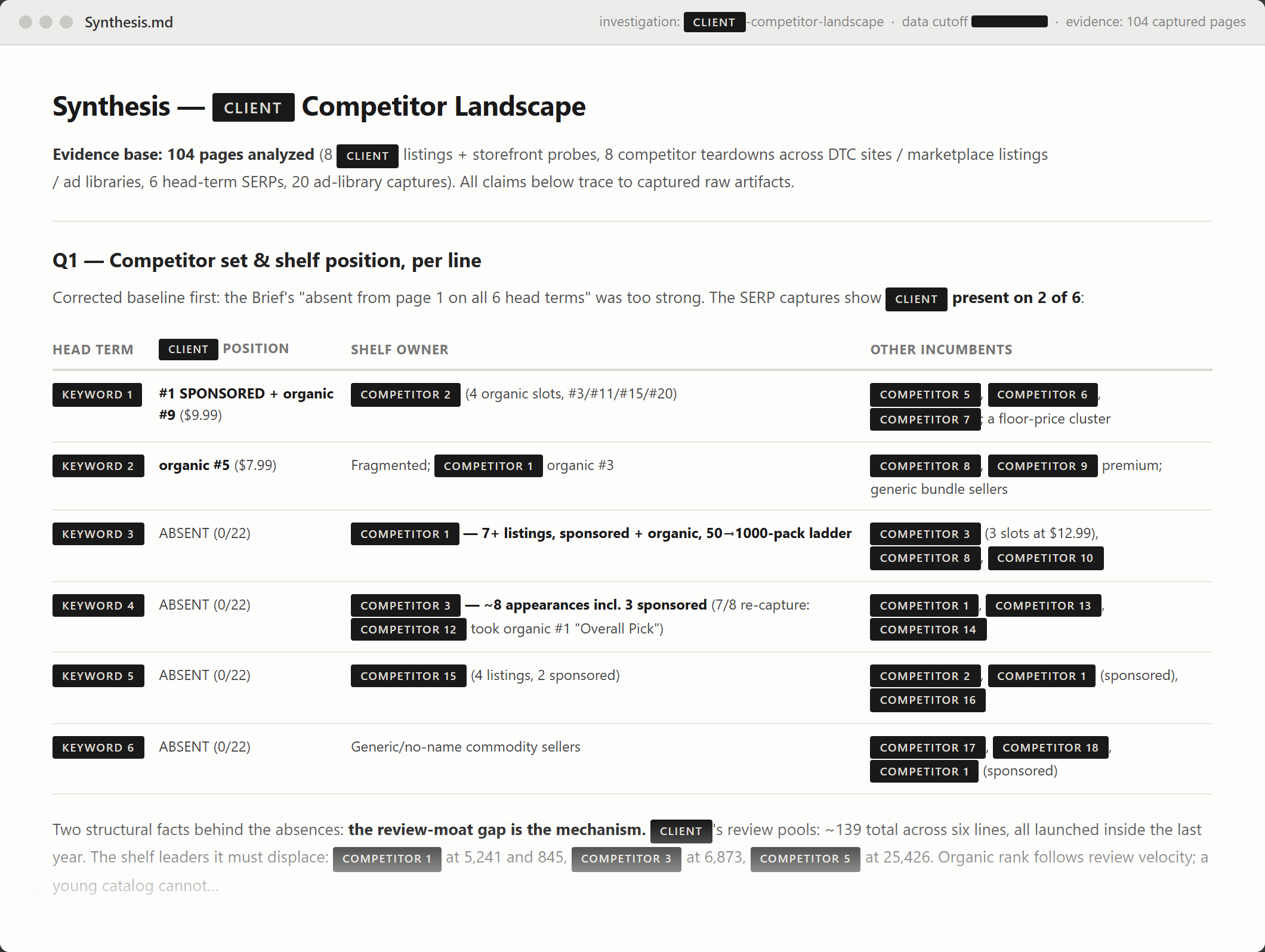
Read this page as text
Synthesis.md    investigation: CLIENT-competitor-landscape · data cutoff [redacted] · evidence: 104 captured pages

Synthesis — CLIENT Competitor Landscape

Evidence base: 104 pages analyzed (8 CLIENT listings + storefront
probes, 8 competitor teardowns across DTC sites / marketplace listings / ad
libraries, 6 head-term SERPs, 20 ad-library captures). All claims below trace
to captured raw artifacts.

Q1 — Competitor set & shelf position, per line

Corrected baseline first: the Brief's "absent from page 1 on all 6 head terms"
was too strong. The SERP captures show CLIENT present on 2 of 6:

Head term | CLIENT position | Shelf owner | Other incumbents
KEYWORD 1 | #1 SPONSORED + organic #9 ($9.99) | COMPETITOR 2 (4 organic slots,
  #3/#11/#15/#20) | COMPETITOR 5, COMPETITOR 6, COMPETITOR 7; a floor-price cluster
KEYWORD 2 | organic #5 ($7.99) | Fragmented; COMPETITOR 1 organic #3 |
  COMPETITOR 8, COMPETITOR 9 premium; generic bundle sellers
KEYWORD 3 | ABSENT (0/22) | COMPETITOR 1 — 7+ listings, sponsored + organic,
  50→1000-pack ladder | COMPETITOR 3 (3 slots at $12.99), COMPETITOR 8, COMPETITOR 10
KEYWORD 4 | ABSENT (0/22) | COMPETITOR 3 — ~8 appearances incl. 3 sponsored
  (7/8 re-capture: COMPETITOR 12 took organic #1 "Overall Pick") | COMPETITOR 1,
  COMPETITOR 13, COMPETITOR 14
KEYWORD 5 | ABSENT (0/22) | COMPETITOR 15 (4 listings, 2 sponsored) |
  COMPETITOR 2, COMPETITOR 1 (sponsored), COMPETITOR 16
KEYWORD 6 | ABSENT (0/22) | Generic/no-name commodity sellers | COMPETITOR 17,
  COMPETITOR 18, COMPETITOR 1 (sponsored)

Two structural facts behind the absences: the review-moat gap is the mechanism.
CLIENT's review pools: ~139 total across six lines, all launched
inside the last year. The shelf leaders it must displace: COMPETITOR 1 at 5,241
and 845, COMPETITOR 3 at 6,873, COMPETITOR 5 at 25,426. Organic rank follows
review velocity; a young catalog cannot…
One recent engagement read 192 competitor pages across 8 firms; another read 226 pages across 13. Every hook, claim, and price point held on file.
- A 13-firm managed-services market where not one competitor had named the buyer's core frustration: the vendor blame-game, where the software vendor blames the server and the server vendor blames the software. That open ground became a single hero line.
- A regulated-software field of 8 firms where a client ranked dead last on trust, while holding the one positioning lane no rival had claimed. We put a clock on how long that lane stays open.
- A field where every firm had planted the same flag, "no hype, just ROI," until the flag marked no ground at all. The buyers' documented fear went unaddressed by all of them.
- A client whose single strongest proof sat buried in an anniversary letter while the homepage ran local tourism content. The fix moved the proof. It didn't manufacture new proof.
Request yours
Tell me the market. I'll tell you what I can see in it.
If the analysis points at something worth building around what you hold, that work is systems building.